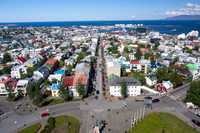
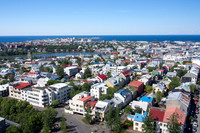
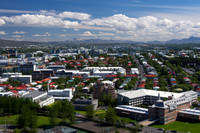
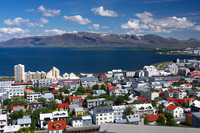
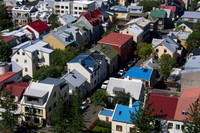
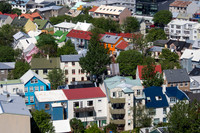
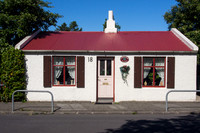
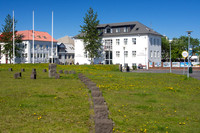
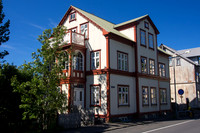
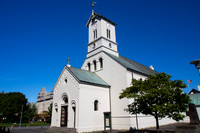
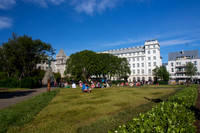
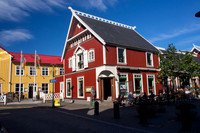
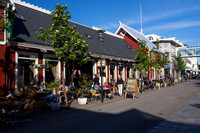
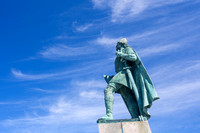
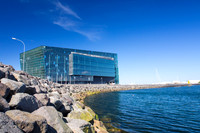
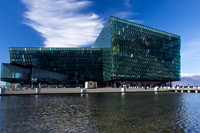
Reykjavik, the capitol city of Iceland, it is the world’s northernmost seat of government. With nearly two-thirds of the island’s population living in Reykjavik, it is also the center of commerce and culture. Nevertheless, it doesn't have a big city feel; in fact is a very walkable city, particularly in Old Reykjavik. During our two sunny days in the capitol we walked pedestrianized streets full of coffee shops; sat by a calm lake (Tjomin) that attracts swans, geese, and Arctic terns; observed the activity in a central park (Austurvollur) that provides a favorite place for lunchtime picnics and for absorbing the sun’s rays on a clear day; visited the sparkling concert hall (Harpa) that is built with an intricate lattice of glass panels; climbed the steeple of a towering church (Halgrimskirkja) that provides panoramic views of the city; went inside the townhall (Radhus) to examine its expansive 3D map of Iceland that shows all the mountains, lakes, rivers, and volcanoes; strolled along the Old Harbor area, from where the whale-watching and puffin-viewing trips depart; visited a couple of excellent museums, including the Vikin Maritime Museum, which portrays Iceland’s seafaring heritage, and the Viking House Museum, which is built around the excavation of a 10th-century Viking long-house and gives an account of Iceland’s initial settlement. To top it off we enjoyed a wonderful fish dinner with our friends.
At the end of our trip around Iceland, we stayed a few days just north of Reykjavik, visiting the famous Golden Circle, which includes Thingvellir National Park, the original Geysir, and the beautiful waterfall Gullfoss. In addition to its beautiful natural setting, Thingvellir is important both historically and geologically. In AD 930 The Vikings established here Europe’s first democratic parliament, the Althingi, and continued to convene there until 1798. It is held in high esteem by all Icelanders, and today it is a protected national shrine.
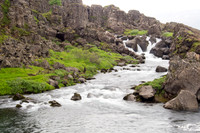
Thingvellir is situated on the tectonic plate boundaries of the mid-Atlantic ridge, the place where the the geological plates of North America and Europe are slowly being pulled apart. We walked along a gorge that shows the rift in dramatic fashion – a high cliff is one edge of the North American plate, and across fissure-ridden valley the Eurasian tectonic plate was slowly moving away.
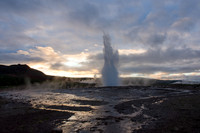
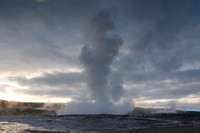
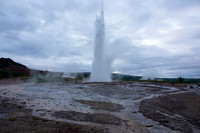
Not far from Thingvellir is Geyser, the original spouting eruption of hot water, after which all the other geysers around are named. Geysir ceased erupting in the 1950s, and only recently (since earthquakes in 2000) has it became periodically active again, but its little brother Stokkur erupts every five or six minutes.
Just up the road is Gullfoss, perhaps Iceland’s most beautiful (and certainly most popular) waterfall. The waters of Hvita river, which originates in the glacier lake Hvitavatn at Langjokull glacier, fall over a three-step staircase and then down two giant steps into a deep gorge, producing a spray that sparkles with the colors of the rainbow on sunny days.
Category:Scenic
Subcategory:Landscapes
Subcategory Detail:
Keywords:Iceland, nature
© Sustaining Images, All Rights Reserved