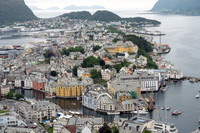
The photos in this set include the beautiful city of Bergen, the Art Nouveau town of Alesund, the university town of Volda, the bird sanctuary island of Runde, and the monastery on the island of Selje. Except for Bergen, our time in the west fjords was in the latter part of our trip, as we made our way back south after exploring the heart of the fjords.
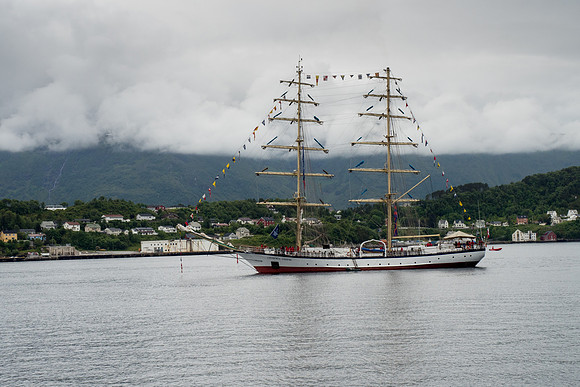
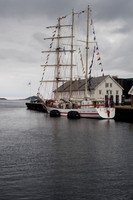
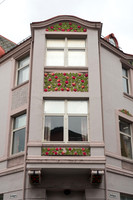
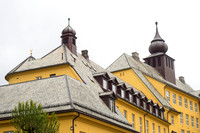
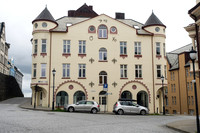
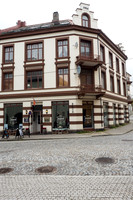
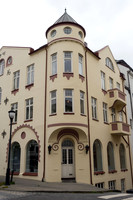
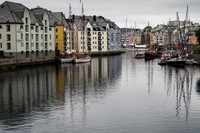
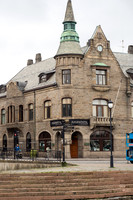
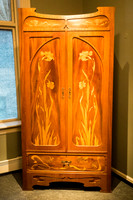
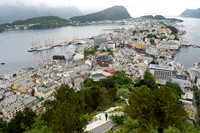
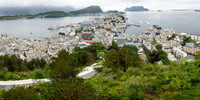
The Art Nouveau town of Alesund, located on the west coast in the Sunnmore region, is viewed by many as the most beautiful city in Norway. Destroyed by fire in 1904, it was rebuilt in that time period’s popular architectural style, English Art Nouveau. This means the buildings are highly decorated, with towers, turrets, and colorful ornaments. Sitting above the town is Mt. Aksla, reached by 418 steps, providing a panoramic view of the city, the nearby islands, and the surrounding mountains and fjords. We were there during a visit of the Tall Ships, when fifty ships from 17 different countries arrived in Alesund as part of the Tall Ships Race 2015. It was a spectacular sight!
The bird paradise island of Runde has only 150 inhabitants, but the population swells to over half million during nesting season from February to August every year, when more than 80 species of sea birds find a home in the spectacular cliffs and grass hills of the island. Runde is the largest sea bird location in Scandinavia. Most famous are the black-and-white puffins, which stay at sea along the coast for most of the year. Joining the puffins are the northern gannets, northern fulmars, and one of the world’s largest shag colonies. On the northwestern side of the island, sitting on a small spot of land beneath the cliffs, is a classic Norwegian lighthouse.
The ruins of Selja monastery lie on a small island just off the coast of the town of Selje. The oldest monastery in Norway, it was built by Benedictine monks in the early 1100s in memory of St. Sunniva, an Irish princess who fled her country to escape a pagan king who wanted to marry her. The wind and ocean currents carried her boat to Selja, where she lived in a cave in the hillside overlooking her landing spot. Sunniva became the guardian saint of Western Norway, and the country’s only female saint. Also on the south side of the island are several Viking graves and the remains of an Iron Age long house.
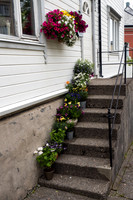
Bergen served as the starting and ending points for our trip. We were there during a beautiful period, full of sun and warmth. After attending a conference at the University of Bergen, we had a couple of days to explore the city. Founded in 1070 AD, Bergen was Norway’s capital in the 13th century and the largest town in Norway until the 1830s. Its size and importance was due to its status as a major seafaring port, one of the most important trading centers for the Hanseatic merchants. Designated as the European City of Culture in 2000, Bergen is filled with wooden houses decorated with thousands of flower boxes, set along cobbled streets with stone steps. The Bryggen area of Bergen, with the Hanseatic Museum and wharf, is on UNESCO’s World Heritage list. Next to Bryggen is the world-famous Fish Market and the old medieval fortress of Bergenhus. In more recent times, Bergen served as the home of the composer Edvard Gried and violinist Ole Bull, giving it a musical heritage that is kept alive today by a number of venues and festivals.
Category:Scenic
Subcategory:Landscapes
Subcategory Detail:
Keywords:
© Sustaining Images, All Rights Reserved